
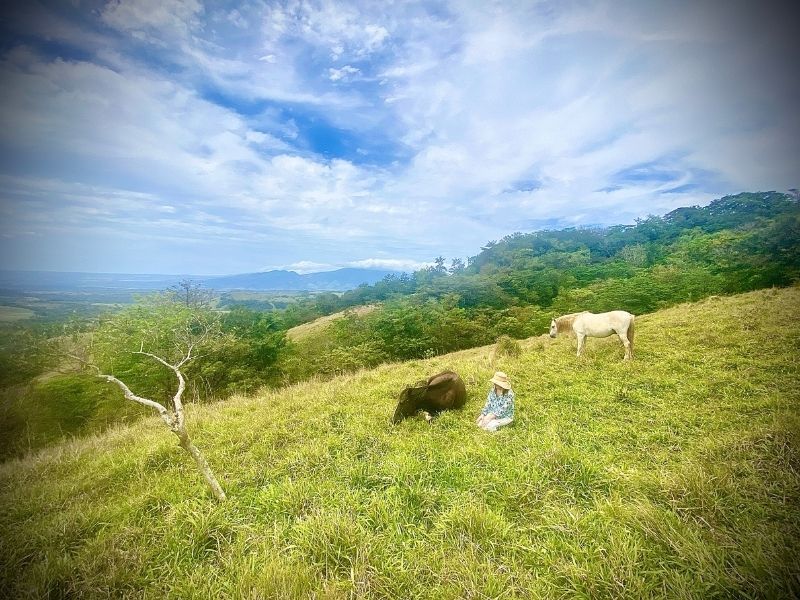
Last week I (Sally) shared how I struggle to give myself permission to rest. Here’s what the practice looks like for me now.
The practice is a process
Being in Costa Rica helps—there’s fresh air everywhere, and nature is an ever-present invitation. The horses are always outside, quietly chewing or resting or wandering, and they regulate the nervous system just by being near. There’s a hummingbird nesting outside the kitchen window. A cheeky horse’s nose peeking in while I’m working. Even the dogs tempt me away from the screen.
And it works. These subtle shifts pull me back into the moment. They interrupt my autopilot and invite me to pause, to breathe, to choose something different.
It doesn’t have to be an hour in the hammock. Sometimes it’s just five minutes in the sun. A slow tea break. A few deep breaths, listening to the wind.
The key—at least for me—has been twofold:
- Building the awareness to notice the habit in the first place.
- Practicing a gentler voice with myself when I do.
That second one is powerful. Instead of “You should rest” or “Why can’t you relax?”, it’s more like: “How is my nervous system doing right now?” “Wow, I feel kind of wired. What would help soften this moment?” “Just take 5 minutes, that feels manageable, and that is enough.”
You can read part one of this post here.
From awareness to choice to change
That’s where real change begins: with compassionate noticing. If I am aware of something, I have a choice – a chance – to do something about it.
It’s probably one of the biggest reasons I moved here. In London, I lived right next to a yoga studio and still hardly ever went. Just getting there—through the rain, past the traffic, into another crowded room—felt like too much. Here, rest slips in through the back door. It’s in the sunshine. The birdsong. The pull of the present moment.
But first, you have to want to change the pattern. It can be uncomfortable to pause long enough to ask: What do I consider work? What do I consider rest? And what do I consider play? Am I out of balance somewhere? And if so—what kind of support would help me gently shift?
Horses v ChatGPT
This is where, for many people who come to Tula Vida, the horses become the turning point. They don’t give you the logical answers you might get on AI. They offer a kind of spacious support where the answers fall away—and something deeper is felt.
Balance doesn’t always arrive in the form of words or goals or steps. Sometimes it’s an embodied experience. A sense of ahh, this is what I’ve been missing. If that sounds a little vague and a little magical, that’s exactly the point.
If I had a formula or a step-by-step process that would work for every nervous system out there, believe me, I’d give it to you. But real rest—real balance—is subtler than that. It’s personal. It’s practiced. And it’s supported by presence.
Sometimes, it takes another being—one who’s not caught up in ideas or busyness—to show us how it’s done.
The horses aren’t waiting for permission to rest. Maybe we don’t have to either.
With love from the land and the herd,
Sally @ Tula Vida