
Most of us are far more compassionate with others than we are with ourselves.
When a friend makes a mistake, we tend to respond with understanding, patience, and care. Yet when we stumble, feel overwhelmed, or react in ways we don’t fully understand, our inner voice can become harsh and unforgiving.
Self-judgment often appears quickly and automatically. We analyze what we did wrong, what we “should have” done differently, and why we aren’t handling things “better.”
But what if there were another way to respond to those moments?
What if, instead of judgment, we chose curiosity?
Curiosity doesn’t demand perfection. It simply invites us to explore what’s happening inside with openness rather than criticism. And that small shift can change everything.
Why self-judgment comes so easily
Self-judgment is often something we learn early in life. Many of us were taught, directly or indirectly, that mistakes needed to be corrected quickly, emotions needed to be controlled, and vulnerability could be uncomfortable or inconvenient.
Over time, that external pressure can become an internal habit. Our minds learn to scan for what’s wrong rather than what’s simply human. When difficult emotions appear — sadness, frustration, grief, or fear — we may immediately ask ourselves questions like: Why am I like this? or Why can’t I just move on?
The problem with this approach is that judgment rarely creates clarity. Instead, it tends to shut down the very awareness we need in order to understand ourselves. When we judge our feelings, we often push them away or try to suppress them. But emotions that are pushed aside rarely disappear — they simply wait for another moment to surface.
The gentle power of curiosity
Curiosity works differently. Instead of trying to fix or control the experience, it invites us to explore it.
When curiosity replaces judgment, our inner dialogue changes. Instead of saying, What’s wrong with me? we might ask, What am I feeling right now? Instead of criticizing our reactions, we might wonder, What might this emotion be trying to tell me?
This subtle shift creates space. Curiosity allows emotions to exist without immediately labeling them as good or bad. And in that space, understanding can begin to grow.
Curiosity also reconnects us with our bodies. When we pause long enough to notice how we feel — the tension in our shoulders, the heaviness in our chest, the restlessness in our breath — we begin to listen more closely to what our nervous system is experiencing.
In many ways, curiosity is an act of kindness toward ourselves.
You can also read: Permission to rest — the rest we resist
What horses can teach us about non-judgment
By interacting with a horse, one can reconnect to the feeling of being accepted without judgement. Horses can sense subtle shifts in energy, emotions, and/or presence. They don’t evaluate or judge what they sense but respond to genuine/authentic energy.
If a person approaches with an anxious feeling, the horse may be more alert; however, when a person approaches seeking calmness and grounding, the horse will usually reflect this energy. Being responsive to one another is not about evaluating or blaming action, it is more about connecting with one another. And horses, as herd animals, are wired for connection.
Being around horses can gently invite us to become more curious about our own internal state. Rather than hiding what we feel, we start to notice it. Rather than pushing emotions away, we begin to observe them with openness.
And in that process, many people discover something surprising: when judgment softens, emotions tend to move and shift naturally.
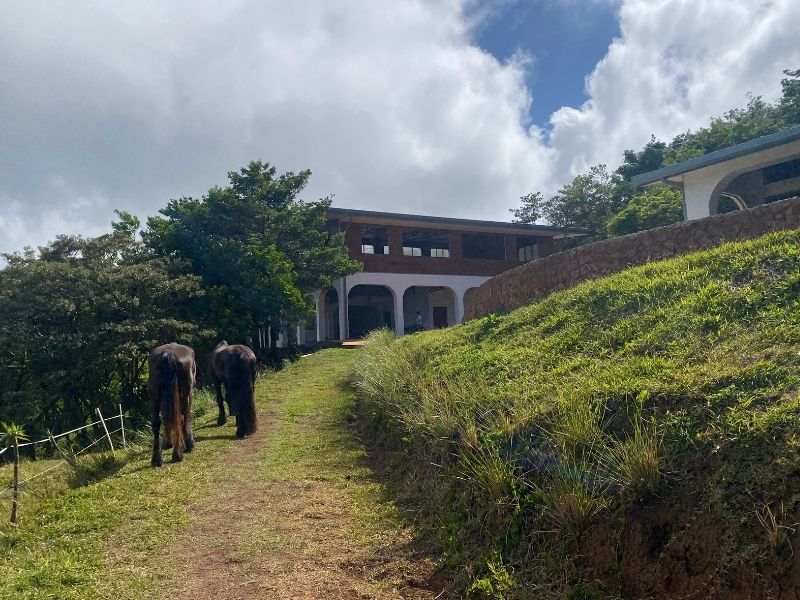
Meet the herd at Tula Vida!
Practicing curiosity in everyday life
There isn’t a sudden switch from judging yourself to having an open mind; it’s a process that takes time and happens in tiny incremental steps.
You can begin by becoming aware of your own internal dialogue, especially when facing a difficult emotion. Before your emotional reaction takes root in your mind, answer the question, “What am I feeling?” and be as honest and as literal as possible.
Another tool we can use that is similar to the first is to be a witness of our emotions, just like we could be witnesses of the clouds moving through the sky. Our feelings come and go; they’ll expand, contract, change, and dissolve with time.
With an open mind, we can experience these various stages of our emotions as an observer rather than the person who is controlling the event. Every time we put this into practice, even if it’s in just a small way, it creates a dramatic change in our relationship to ourselves.
Tula Vida’s mission is to support you in a deeper connection with yourself, through horses, nature and experience.