
Many of us move through life trying to manage our emotions rather than truly feeling them. I know I (Sally) certainly used to. In fact, for many many years emotions were inconvenient and confusing things I tried hard to suppress or ignore.
Sadness becomes something to fix. Anger becomes something to hide. Even joy can feel uncomfortable if we’re not used to allowing it fully. We paste a smile on and say we are “fine” with a sinking feeling or a swirling going on inside. Have another cup of tea and a cookie. Pick up our phone. Answer an email.
Somewhere along the way, we learn that certain emotions are acceptable while others are not. There is a saying that anger is the only accepted emotion in the workplace – but for many of us it was easier to express no emotions (other than happiness) at all.
After many years of doing a different kind of work (coaching with horses), I have come to learn that feelings are simply signals — messages from the body and the heart asking to be noticed. Not something to panic about.
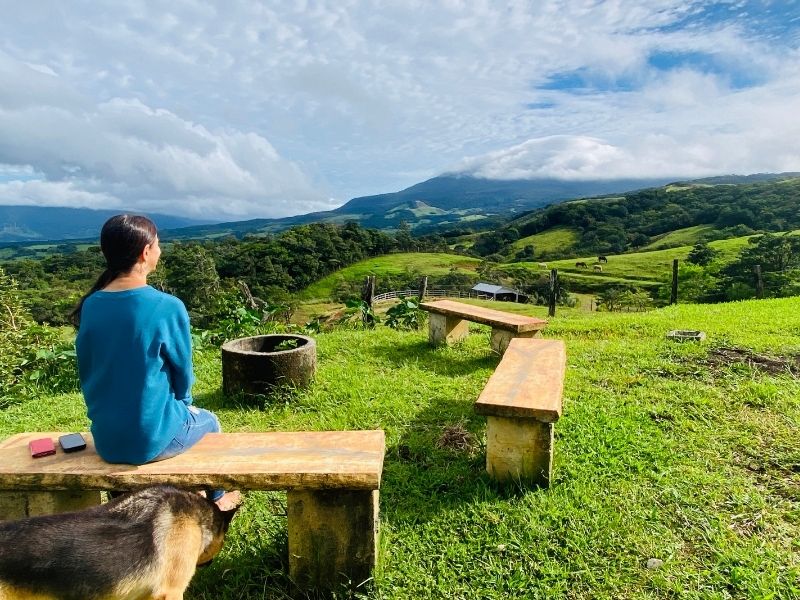
In spaces where nature and horses are present, something different begins to happen. Without the usual noise and social pressure, people often rediscover something they may not have experienced in a long time: the freedom to feel without judgment.
Why we learn to judge our feelings
Many of us are taught, from a very young age, to “regulate” our emotions by controlling them. Maybe you heard expressions like “don’t cry,” “you’re overreacting,” or “calm down.” These messages, even though they are often given with good intentions (those who took care of us were doing what they could, with the tools they had at the time, and that’s okay), can slowly teach us that certain emotions are inconvenient or just wrong.
As time goes by, we begin to monitor ourselves internally. Instead of questioning, “What am I feeling?” We ask, “Should I be feeling this?” The result is a constant layer of self-criticism that sits on top of our natural emotional experience.
This inner judgment can create tension in the body and mind. Feelings that are not allowed to surface do not disappear—they simply get stored. Stress, anxiety, and emotional fatigue build – and sometimes burst out sideways at unexpected moments, like the rage you feel sitting in traffic, or sobbing uncontrollably to your favourite song. And we don’t really even know where they came from, let alone what to do with them.
What horses teach us about emotional honesty
At Tula Vida, we’ve seen that our rescue horses live in complete alignment with what they’re feeling. If they feel curious, they approach you. If they feel uncertain, they pause. If they feel calm, they simply rest. If they feel scared, they may run. A horse doesn’t judge their experience; they just respond to it in a way that feels right.
Since horses are tremendously sensitive to our energy, they often magnify the emotions people bring with them. If someone at the ranch feels stressed, the herd may become more alert. On the other hand, when people soften, the horses do so as well. This reflection can be surprisingly powerful. You get to see what you are feeling, and get positive feedback when you let yourself feel it.
What makes this interaction unique is that horses do not judge what they sense. They simply respond to it. For many people, being in the presence of a being that accepts emotional truth without criticism creates a rare sense of permission: it becomes safe to feel whatever is there. Not to change it, or get rid of it, just to feel it.
Allowing feelings to move through you
Emotions are meant to move. Like a wave, they rise, shift, and eventually settle when they are acknowledged. Problems tend to arise when we resist or suppress them. The waves builds up like a dam trying to burst through.
Allowing yourself to feel does not mean being overwhelmed by emotion. It means noticing what is present with curiosity rather than criticism. Surfing the wave as you notice it. You might recognize tension in your chest, heaviness in your stomach, or a wave of sadness that wants space to be felt. We teach you the tools you need to make this feel possible and natural.
Why do it?
When you pause and allow these sensations without immediately trying to change them, the nervous system begins to regulate. The body recognizes that it is ok to process what it has been holding. Often, the intensity softens more quickly than expected once judgment is removed. And all that energy you have been using to hold things back and be “fine” is now available for what you really want to do.
You might like to read: Are you holding space for yourself?
The gentle practice of self-compassion
Learning to feel without judgment is a practice, not a destination. It begins with small moments of awareness: pausing during the day to check in with yourself, noticing emotions as they arise, and responding with kindness instead of critique.
Nature helps make this process easier. The land does not demand explanations. The wind does not ask you to justify your feelings. Horses do not question whether your emotions are valid. Their presence reminds us that being human includes the full spectrum of emotional experience.
The next time you notice a feeling arise, try asking yourself a different question. Not “Why am I feeling this?” or “How do I fix it?”
Put simply: “What is here right now, and can I allow it to exist?”
Sometimes that single shift — from judgment to curiosity — is where shift quietly begins.
A reminder
By the way, we each do have all the emotions. Many times. It is part of our shared experience as humans – and may actually be a relief to not feel alone in it.
If you believe you don’t have certain feelings, or you have no idea what they are, then that may be a sign you are so used to blocking them that things have gone numb. And it may be numbing some of the joy or excitement you want to feel too. But it can always change – there is a path. We can help.