
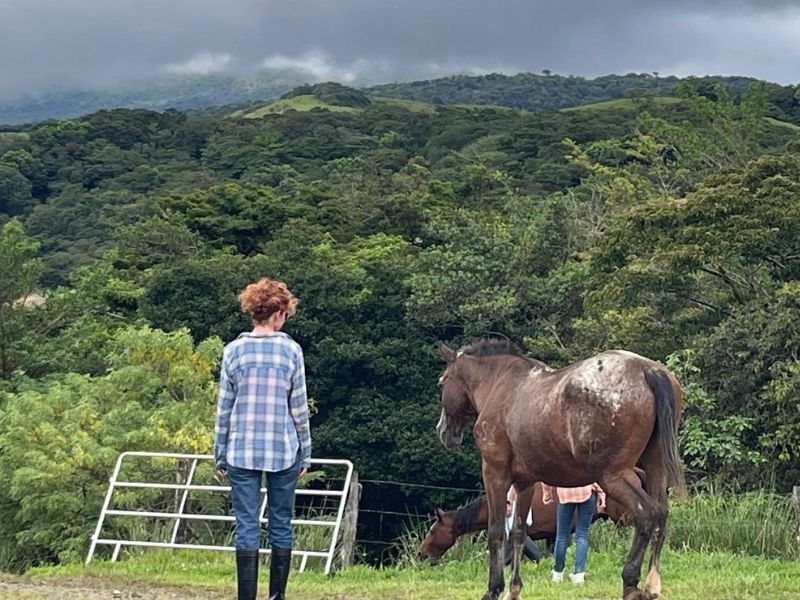
We often think of communication as something that happens through words, facial expressions, or gestures. But beneath the surface of our spoken conversations, a much deeper, quieter dialogue is constantly taking place. You may have heard that between 70-90% of our communication is non-verbal. Our nervous systems are always talking to one another, reading subtle shifts in muscle tension, breathing patterns, and heart rates.
This natural, biological process is known as “co-regulation.”
Simply put, co-regulation is the way two living nervous systems interact to help each other find balance and safety. To survive. It is an inherent design that exists in mammalian bodies, allowing us to quieten our internal alarms by simply being near a calm, grounded system. When we spend time around someone who is deeply relaxed, our own body naturally mimics that state of ease. Conversely, if we spend time around someone who is highly anxious, our own system can easily catch that underlying rush without us even realising it.
Can you think of someone you just naturally feel better around, who you go to when you need a dose of calm? And someone who you leave feeling more stressed, more anxious? That is because it is catching!
What do you think your nervous system is communicating right now?
The hidden conversation between nervous systems
Our bodies are wired to seek out cues of safety from our surroundings. From the moment we are born, we rely on others to soothe our internal stress. A caregiver holding a crying infant is a classic example; the child’s frantic system leans entirely on the adult’s steady heartbeat and slow breathing to find its way back to quietness. The body inherently understands this physical signal.
As adults, we still carry this biological need, yet we frequently forget to look after it. In a busy world, we are often surrounded by high-alert systems—congested traffic, crowded spaces, and digital alerts. When everyone around us operates on survival energy, our bodies store that tension. We find ourselves in chronic high alert, unable to fully settle because our environment rarely offers clear signals of deep relaxation. This is why finding naturally grounded spaces becomes so important for our well-being.
You might like: What happens when you match your breathing to a horse’s?
Also watch our upcoming webinars on nervous systems (see our YouTube channel for replays).
The wisdom of the herd
When you step out onto the land and spend time at the ranch, you observe co-regulation in its purest, most ancient form. For horses, this practice is not a wellness choice; it is a fundamental matter of survival. And they are great at it.
Because a horse is a prey animal, she is incredibly sensitive to the energy and movement of her environment. Her life depends on her capacity to notice the slightest shift in the atmosphere or the collective state of the herd. If a single mare senses a threat, her nervous system instantly spikes into high alert, and within a fraction of a second, the entire herd is ready to move. This rapid sharing of survival data keeps them alive.
However, staying on high alert consumes an immense amount of energy. Therefore, horses must be efficient at bringing their systems back down to rest. Once a perceived threat has passed, a lead gelding might take a massive, audible breath and let his lower jaw soften completely. As the other horses notice his physical release, a wave of calm ripples through the entire group. They co-regulate one another back into safety, lowering their heads to graze together in peace.
What if we could learn to do that same?
Tuning into a slower rhythm
When we arrive at Tula Vida ranch, we are invited to join them in their experience of safety. A horse gives you no need to pretend or perform. If you go up to a horse with a lot of inner excitement within you, he’ll notice that your heart rate is increased and that you’re breathing shallowly. He may move away from you not out of rejection but because he will mirror your state – so you become aware of it too. You get to understand your own system better through his feedback.
When you stop, stand quietly in nature, and pay attention to your own body—then a wonderful transformation will take place. A horse has a large heart, and his natural rhythm of breathing is slower than your breathing. While standing next to him, your nervous system will automatically hook on to his calm and steady presence.
Your body will start to experience the physical signs of what it has longed for without a word being spoken. You may find your breathing starting to match the way that he breathes deeply. When he sighs out a long and low sound of relief, your shoulders will begin to untense, finally giving them the room they need to drop. Your frantic thoughts start to sync with the steady rhythm of the earth under his hooves. This is co-regulation, what your body has always known how to do physically.
And this is why people return again and again to Tula Vida Ranch, and to horses.
See more of Tula Vida’s stories and reflections.
Allowing the body to remember
Learning to co-regulate with the herd reminds us that we do not have to generate calm entirely on our own through sheer willpower. Sometimes, the most supportive thing we can do is place our physical body in an environment that already knows how to rest. By spending time near the horses, your nervous system gets to practise what genuine ease feels like—a physical memory you can carry back into your daily routine as a natural rhythm you can always return to.
Perhaps you spent time with horses (or other animals) as a child, and you always wondered why you feel so much better around them….now you know! It’s biology, as well as love.