
There are stories from this land that we sit with for a long time before we know how to tell them. This is one of them.
In the space of a few weeks earlier this year, two horses arrived at Tula Vida within days of each other. One was tiny and failing. One was enormous and lost. They had nothing in common except this: they had both been through too much, and they both needed somewhere safe to land.
This is their story. And in some ways, it might be yours too.
Noah
He arrived on 21 April.
He was one of the thinnest horses we had ever seen — sores on his skin, ear infections, protruding bones, a dull eye. A little pony. And yet, from the very first day, there was something about him. A quiet strength of spirit that was immediately, unmistakably clear.
He had been rescued from auction months earlier by our friend Berrit, along with four other horses in terrible condition. The others began to recover. Noah didn’t. When his new owners reached out to us with photos and worrying updates, asking if we could take him for intensive care, we said yes.
Within days of arriving, the light started coming back into his eye. He loved his food. He would hear the feed bucket from across the field and run — or as close to running as his small, fragile body could manage — to get to it first. He was curious. He was sweet. He began, slowly and quietly, to enjoy life.
And then he found a friend.
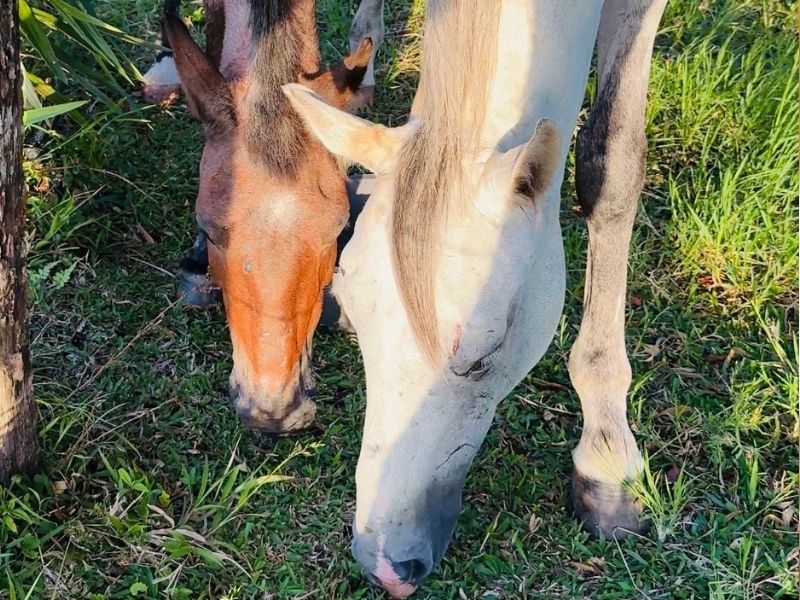
We were watching him one afternoon, not long after he arrived, when we noticed something had shifted. He was standing close to another horse — a tall, silver, deeply anxious ex-racehorse named Nickel, who had only just arrived himself. They were simply standing together. Quietly. And Nickel, who had been running, fighting or shutting down since the moment he got here, was still.
We will come back to Nickel in a moment. But first, Noah.
Despite everything we tried — the medicine, the supplements, the intensive treatments, the constant care and love — Noah’s condition was too advanced. His body had simply been through too much for too long. One morning, we found him lying in the field, unable to get up.
He was lying under a rainbow. And — this is the kind of thing that happens here — on the exact spot where one of our other spirit horses, Ona, is buried.
We brought him in. We sat with him. His owners came that day — they had never been able to meet him in person before — and they were lovingly with him at the end. So were we. So was Nickel. The whole herd came and went outside his stall throughout the day, paying their respects in the way horses do — quietly, presently, without looking away.
He was surrounded by love. In a place where he had known kindness, perhaps for the first time in his life.
The vet came and helped him go peacefully.
Sally wrote this for him afterwards:
So strong and so tough, so wise and so brave,
The story of strength and hope that you gave,
Physical limits, a small and weak frame,
But limitless spirit, pride without shame.
And now you fly free, with no need to perform —
Your essence was never contained by your form.
He is buried on the land now. He is a spirit horse. And we are so glad he came.
Nickel
Nickel’s story is a different kind of hard.
He is seven years old — young — and silver, the colour of metal, which is how he got his name. He is tall and striking and, when he arrived, deeply, deeply anxious. He had spent most of his life as a racehorse in Panama: taken out of a stall to run, put back in. Sold to a riding school in San José, where he developed back problems, lost too much weight, and eventually became too costly and too broken to be useful. His owner asked our vet to put him down.
Our vet called us instead.
We didn’t have room, or funds, for a giant, sensitive, injured ex-racehorse. We said yes anyway.
He arrived not knowing how to be in a herd. Not knowing how to regulate or calm himself. He either picked a fight or ran around in a panic. He had no concept of personal space. He would walk straight into you, not out of aggression, but because pushing through was the only survival strategy he knew. It had kept him safe. It was all he had.
We put him in the recovery pasture with Noah.
And something happened.
Noah — small, steady, unbothered by drama — became Nickel’s anchor. He didn’t fuss over him or try to fix him. He just was himself: calm, grounded, present. Safe. And Nickel, this enormous nervous animal, settled beside him. They became each other’s first real friend.
He cribs — a repetitive, dramatic self-soothing habit, formed when no other comfort is available. It tells you something about what his early life felt like. He wants connection desperately, but doesn’t yet know how to have it without panicking or lashing out and overwhelming everything around him.
Sometimes, when someone has never really felt safe and secure, their nervous system learns to stay on high alert — running on fight, flight or freeze, or some exhausting combination of all three. Deep rest becomes difficult. Digestion suffers. Even friendship feels dangerous. Health starts to unravel. Nickel is a living example of this. And he is also living proof that it is never too late to begin again.
You can meet the herd here.
Sound familiar?
Eric works with him every day now. Softly, consistently, patiently. Teaching him that humans can be trusted. That an ask is not a threat. That being told no doesn’t mean the relationship is over. Baba, one of our most grounded horses, has taken Noah’s place as his anchor — offering the same gift: closeness without pressure.
He is not ready to be around guests yet. But he is learning. Slowly, honestly, one day at a time. Nothing, it turns out, is too far gone for hope.
A life doesn’t have to be long to matter. Noah taught us that.
We lost one and we are tending the other. That is the truth of this season at Tula Vida.
Grief and hope, side by side in the same field.
Nickel’s story is still unfolding. We will share it in Part 3.