
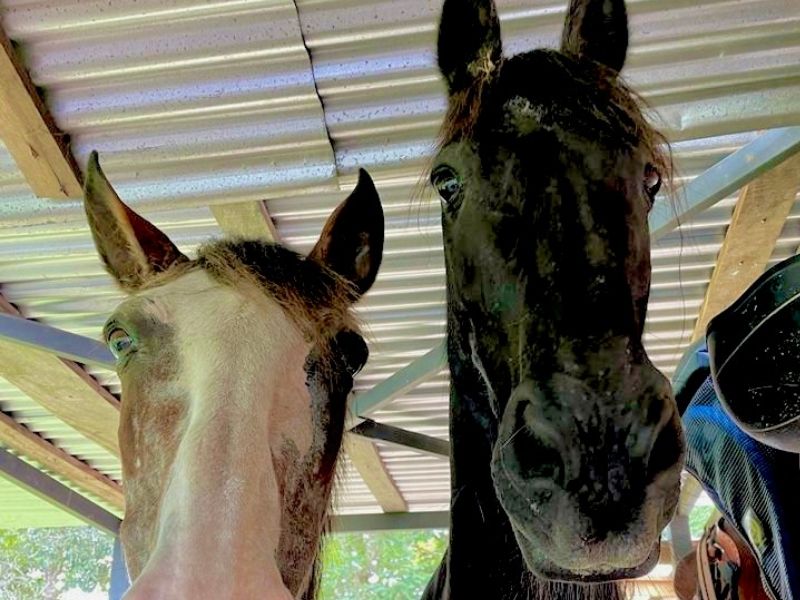
There’s something quietly humbling about standing beside a horse. You may think you’re just being there — calm, present, relaxed — but the horse might be noticing something else entirely. They may notice a subtle tightness in your shoulders, a held breath, or some other indication that you are not completely at ease in this moment, but, rather, that there is a feeling of some disconnectedness.
The horse has the ability to hang onto what is truly real—not the you you display to them, but the you who exists at this time and place. When you are in the presence of a horse, you begin to gain an understanding that there are things and feelings occurring below the surface and that there is a good chance that you are unaware of those feelings or experiences.
At Tula Vida, this awareness becomes an invitation. Not to judge yourself, but to gently see yourself more clearly.
The energy beneath your actions
We often focus on what we’re doing — saying the right thing, moving the right way, trying to “get it right.” But horses respond to something deeper: the energy behind those actions.
You might approach a horse slowly and gently, but if inside you feel anxious or uncertain, they’ll sense it. Not as a flaw, but as information. Horses recognize consistency between your inner state and outer behavior. When those don’t match, they may hesitate, step away, or simply stay alert.
This isn’t rejection — it’s feedback. A quiet reflection of what’s happening within you. And in that reflection, you’re given a chance to notice what you might have overlooked.
The subtle signals in your body
Your body is always communicating, even when you’re not aware of it. The way you hold tension, the pace of your breath, the direction of your gaze — these small signals speak loudly in the world of a horse.
You might not realize you’re holding your breath, but the horse feels that pause. You might not notice your shoulders tightening, but they sense the shift in your energy. Horses are masters of reading these cues because their safety depends on it.
Being around them brings your awareness back to your body. You begin to notice what you’re feeling physically, not just mentally. And that awareness is the first step toward softening, grounding, and reconnecting.
You can also read: When did you last allow yourself to feel without judgment?
Your emotional state, unfiltered
Horses don’t need words to understand emotion. They don’t analyze or interpret — they simply feel what’s present. If you’re calm, they relax. If you’re unsettled, they become more alert. If you soften, they often soften too.
What’s powerful is that they respond to your true emotional state, not the one you try to present. You might think you’re fine, but if there’s tension underneath, they’ll notice. And in doing so, they gently bring that awareness to the surface.
This can feel surprising at first, but it’s also deeply supportive. Horses don’t judge what they sense. They simply respond. And that creates a space where you can begin to meet yourself with the same honesty.
You can see all of our blog posts here.
When you’re truly present
Perhaps the most beautiful thing horses notice is when you’re fully here. Not distracted, not overthinking, not trying to control the outcome — just present.
In those moments, something shifts. The horse may step closer, lower their head, or simply stand beside you in quiet connection. There’s a sense of ease, a shared rhythm, a feeling that nothing needs to be forced.
This is often when people realize what presence actually feels like. Not as an idea, but as an experience — one that is felt in the body, reflected by the horse, and grounded in the moment.
An invitation to see yourself more clearly
What horses notice isn’t meant to be intimidating — it’s meant to be illuminating. They show you the parts of yourself that are often overlooked, not to point out flaws, but to guide you toward awareness.
At Tula Vida, these moments become opportunities for gentle self-discovery. You begin to see how your energy, emotions, and body are all connected. And with that awareness, you gain the ability to shift — not by force, but through presence.
In the end, horses don’t just notice you. They help you notice yourself. And in that quiet recognition, something begins to change.