
If you’ve ever wondered why rest feels so hard for high-achievers, you’re not alone.
What is “Rest” anyway?
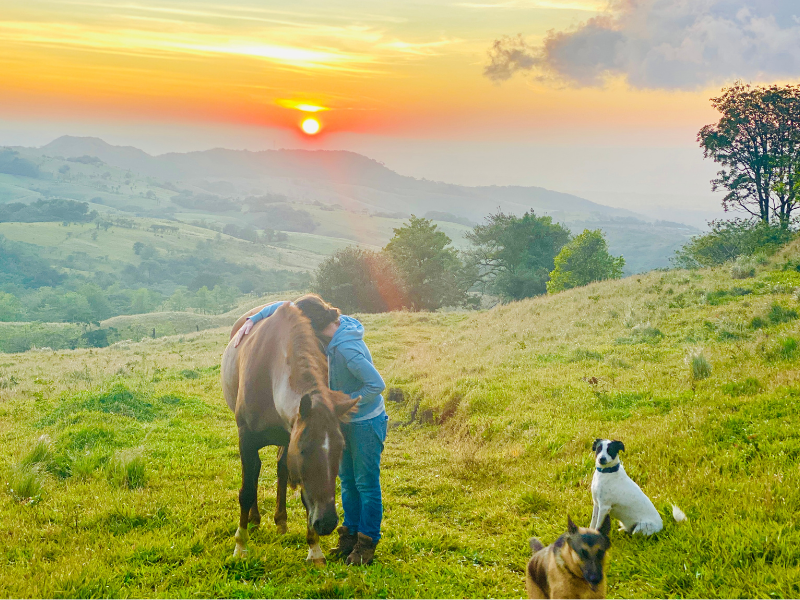
Some days, my version of resting is two minutes with my forehead against a horse’s side, listening to that huge, slow breathing, before I go straight back to my desk. That’s it. That’s the whole rest. And for years I would have told you that didn’t count — that “real” rest needed to be an hour, an evening, a holiday, or it wasn’t worth bothering with.
I don’t think that anymore. Those two minutes count. They count more than I expected them to.
For fifteen years I pushed through on five or six hours’ sleep and told myself I was fine — genuinely fine, I wasn’t being brave about it, I actually believed it. It was only after I moved to Costa Rica and started sleeping eight or nine hours a night that I realised what “fine” had actually felt like: tired.
I’d been tired for fifteen years and called it normal.
Waiting for the “right conditions” to arrive
That’s the trap for a lot of high-achievers. It’s not that we can’t rest — it’s that we’ve quietly decided rest only counts if it’s substantial. Small pauses get dismissed as not really trying. So we hold out for the big block of time that never quite arrives, and skip the two minutes that were sitting right there.
There’s also a stranger problem, which is that free time doesn’t automatically produce rest.
I was at the beach recently — no laptop, nothing to do, exactly the kind of stretch that should have felt easy — and I couldn’t settle at all. The moment the calendar cleared, my mind sped up rather than down, cycling through everything I “should” be doing instead.
What actually worked was giving my mind a job: I picked up a book. Not to switch off entirely, just to give the busy part of my brain something small to chew on, so the rest of me could gradually start soaking in the sea and the quiet without my mind fighting it the whole time.
If you’ve been trying to think your way out of stress, you might be interested in: Why stress is not an intellectual problem
What does resting say about me?
Somewhere along the way, a lot of us learned our worth was tied to what we got done. Slowing down started to feel less like care and more like something to earn. And even when the diary does clear, the mind doesn’t automatically follow — a nervous system that’s been switched on for years doesn’t switch off just because you’ve booked the time. It keeps scanning, keeps bracing. Rest feels unfamiliar, and unfamiliar reads as unsafe.
But rest is not the opposite of success. Rest is something we need to feel deeply – and something we need to allow our nervous systems to do so they not stuck in constant cycle of doing, running, fight / flight / freeze.
Signs your nervous system may be stuck in “doing mode”
You may recognize some of these common signs:
- Feeling guilty when you’re not being productive
- Constantly thinking about your to-do list
- Struggling to sit still or relax
- Feeling restless during vacations
- Difficulty enjoying downtime
- Needing to stay busy to feel accomplished
- Feeling anxious when there’s “nothing to do”
If any of these resonate with you, you’re not failing at rest. Your body may simply be operating from patterns that have been reinforced for years.
Joining the horse herd invites us into rest
This is where I think a horse does something we can’t manufacture for ourselves. Roh (in this photo) isn’t impressed by your inbox. There’s no performance required, no assessment of whether two minutes was “enough” — which, if you’ve spent years being assessed, is rather a relief.
A horse will run from a scary sound, then wander straight back to munching grass moments later. He’ll lie flat out and snooze the second the sun comes out. Horses know how to rest deeply, properly, without any of the guilt we’ve learned to attach to it — and being around them can show us how to do the same.
Their enormous hearts and finely tuned nervous systems can actually co-regulate ours. Stand with the herd for a few minutes and you may notice yourself yawning, or suddenly aware of how tired you actually are — your body picking up on theirs and finally admitting what it’s been carrying.
And it doesn’t have to be a horse, or two minutes exactly, or a book at the beach. It’s the size of the permission that matters, not the size of the pause. Rest isn’t the reward you earn after the work — it’s what stops you burning out, so that, ironically, the work can carry on.
What healthy rest actually looks like
It does not need to look like doing nothing. It might be two minutes with your forehead against a horse’s side. A book in the hammock that gives your mind a small job so the rest of you can settle. Standing with the herd and letting a yawn arrive uninvited. None of it needs an hour, and none of it needs to be earned first.
If you’ve spent years strengthening the muscle of achievement, the muscle of rest can feel unfamiliar and weak to start with. That’s alright. It comes back — two minutes, one long breath, one forehead against something warm and breathing, at a time.
Come and remember what that feels like.